


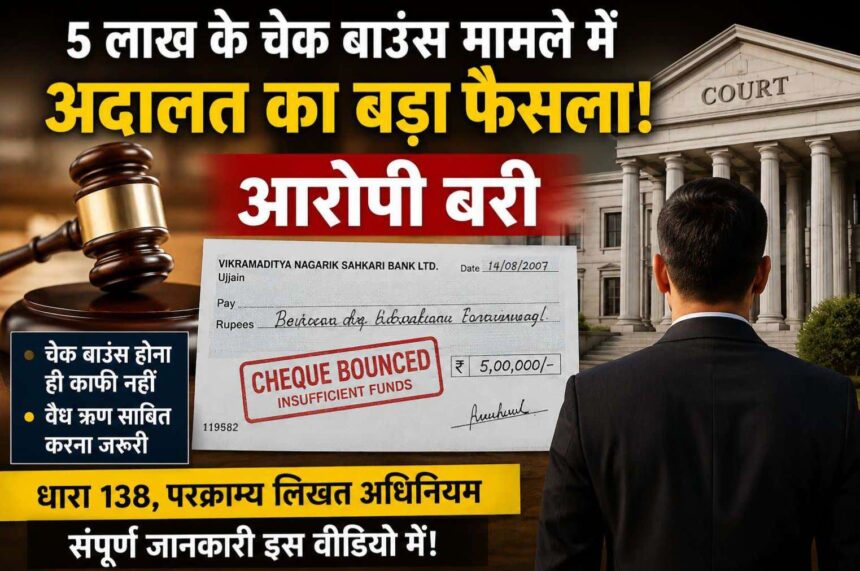
Almora: In a significant judgment, the Judicial Magistrate’s Court in Almora has acquitted the accused, Sumit Mehta, in a cheque bounce case involving ₹5 lakh. Delivering its verdict after nearly two years of trial, the court held that the complainant failed to establish, through reliable and convincing evidence, that the cheque had been issued towards repayment of a legally enforceable debt.
According to the complaint, Tej Singh Rathore alleged that he had advanced ₹5 lakh to the accused as a friendly loan for business purposes due to their close personal relationship. He claimed that the accused issued a cheque dated April 2, 2024, which was presented for encashment on April 3, 2024. The cheque was returned unpaid the following day with the remark “Funds Insufficient.” After serving a statutory legal notice and receiving no payment within the prescribed period, the complainant initiated proceedings under Section 138 of the Negotiable Instruments Act, 1881.
During the trial, the accused denied all allegations and contended that there was no personal financial transaction between the parties. The defence argued that the complainant had invested money in Sahara India, where the accused had worked as an agent. According to the defence, after the investment became unrecoverable, a signed cheque allegedly kept at the company’s office was misused, leading to the present complaint.
After examining the oral testimonies, documentary evidence and legal submissions, the court observed that the complainant had failed to specify the exact date on which the alleged loan was advanced, the mode of payment, or produce independent documentary proof supporting the transaction. The court considered these omissions to be material deficiencies in the prosecution’s case.
The judgment further observed that dishonour of a cheque alone is insufficient to establish an offence under Section 138 of the Negotiable Instruments Act. The complainant must also prove that the cheque was issued in discharge of a legally enforceable debt or liability.
Referring to several Supreme Court precedents, the court noted that although statutory presumptions initially operate in favour of the complainant, such presumptions are rebuttable. If the accused succeeds in raising a probable defence and the complainant fails to substantiate the alleged debt with credible evidence, a conviction cannot be sustained.
Holding that the complainant failed to prove the essential ingredients of the offence beyond the required legal standard, the Judicial Magistrate acquitted Sumit Mehta of all charges under Section 138 of the Negotiable Instruments Act.
Legal experts believe the ruling reinforces the principle that in cheque dishonour cases, proving the existence of a legally enforceable debt is as important as proving the dishonour of the cheque itself.