


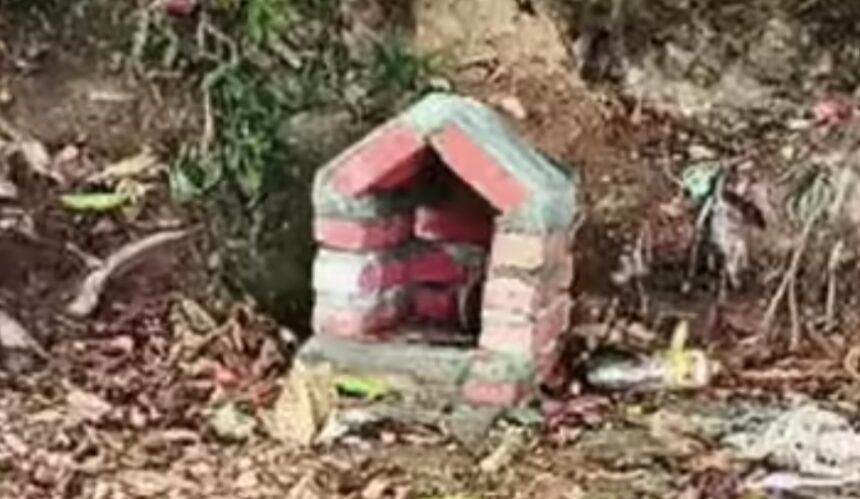

Bageshwar: A government school in Kausani in Uttarakhand’s Kumaon region has landed in controversy after a small ‘temple’ was constructed within its campus, allegedly to “appease the spirit” believed to be haunting the premises for nearly three decades. The issue has now drawn the attention of the education department, which has ordered an official inquiry.
According to sources, the temple was built following a series of incidents in which several girl students reportedly fell unconscious under unexplained circumstances. These incidents fueled fear among students, parents, and even some staff members, leading to the belief that the school was haunted by the spirit of a man.
Locals claim that the spirit is that of a Nepali labourer who died in an accidental fall near the school around 30 years ago. Over time, the story became part of local folklore, creating a sense of unease around the area.
Fear Among Students Led to Decision
A teacher at the school, speaking on condition of anonymity, said that initial efforts were made to address the situation through counselling sessions for the affected students. However, as incidents continued, traditional beliefs began to influence decision-making.
“In the hills, faith in both deities and spirits is strong. The temple was seen as a way to reduce fear among students and create a more secure environment,” the teacher said.
PTA Collected Funds for Construction
The construction of the structure was reportedly initiated in January this year by the school’s Parent Teacher Association (PTA). Around 218 students from Classes 6 to 12 were asked to contribute ₹100 each, raising approximately ₹21,800. The total cost of the temple is estimated to be around ₹25,000, with additional contributions coming from teachers and some parents.
PTA president Chandan Singh Bhandari defended the decision, stating that the move was taken in the interest of students’ well-being. “Students were frequently falling ill or fainting. We felt this step might help restore normalcy,” he said.
School Administration Defends Move
School principal Tajbar Singh Negi clarified that the funds were collected with the consent of parents during a PTA meeting. He maintained that the intention was not religious promotion, but rather to ensure a peaceful academic atmosphere.
“Our aim was to create a calm and fear-free environment for students. Along with the structure, we also focused on cleaning and maintaining the campus,” Negi said.
Questions Raised Over Fund Use
The matter took a controversial turn when some parents and students began questioning both the need for the temple and the manner in which funds were collected and utilized. Critics argue that constructing a religious structure within a government school and collecting money from students raises ethical and administrative concerns.
Some parents also pointed out that the fainting incidents could have medical or psychological causes, which may not have been adequately investigated.
Education Department Orders Probe
Following the growing controversy, the district education authorities stepped in and ordered an inquiry. Chief Education Officer Vinay Kumar stated that strict action would be taken if any irregularities are found.
“The matter is under investigation. The Block Education Officer in Garur has been assigned to conduct a detailed inquiry. Appropriate action will follow based on the findings,” he said.
Debate Over Superstition vs Scientific Approach
The incident has reignited a broader debate on the role of superstition in educational institutions, especially in rural and hill regions. While traditional beliefs remain deeply rooted in local culture, experts emphasize the importance of addressing such issues through scientific reasoning and proper counselling.
Psychologists suggest that the fainting episodes could be linked to stress, anxiety, or mass hysteria, conditions that require medical attention and awareness rather than supernatural explanations.
Conclusion
The controversy surrounding the Kausani school highlights the delicate balance between cultural beliefs and modern education. As the inquiry progresses, it is expected to bring clarity on the legitimacy of the actions taken by the school authorities and PTA.
The outcome may also set an important precedent on how similar situations should be handled in educational institutions, ensuring that students’ well-being is addressed through informed and rational approaches rather than fear-driven measures.