


Dhami government emphasises uniform educational regulations; Minority Education Authority to oversee recognition and academic standards
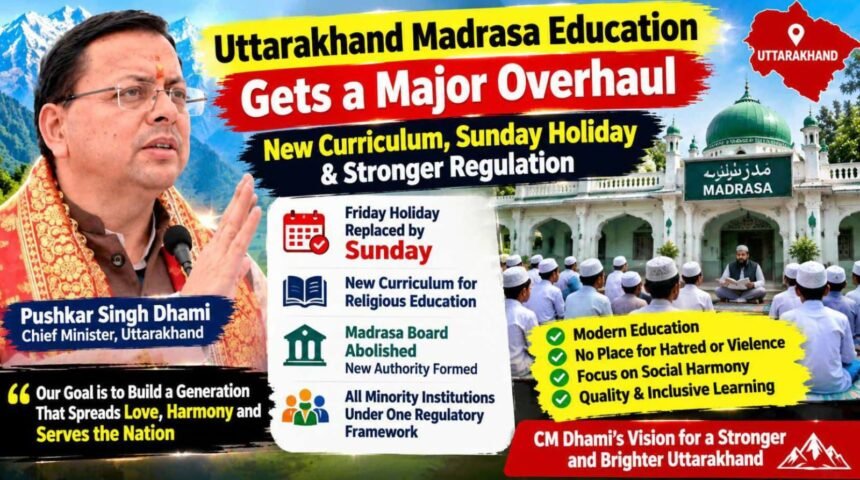
Dehradun, Uttarakhand: The Uttarakhand government, led by Chief Minister Pushkar Singh Dhami, has introduced significant changes to the regulatory framework governing minority educational institutions, including madrasas. The latest development is the shift from Friday to Sunday as the weekly holiday for madrasas recognised by the state education authorities or seeking recognition under the prescribed system.
The move follows the replacement of the Uttarakhand Madrasa Education Board with the Uttarakhand State Authority for Minority Education (USAME), which is responsible for overseeing recognition and academic standards for educational institutions run by notified minority communities.
According to reports published on October 21, 2026, the revised weekly holiday arrangement is intended to bring recognised madrasas in line with the schedule followed by other schools in the state. The change reportedly affects around 206 madrasas that have obtained or applied for recognition.
Madrasa Board replaced by a new authority
The state government introduced a new legislative framework in 2025 to replace the previous system governing madrasa education. The new arrangement came into effect in July 2026, bringing educational institutions run by six notified minority communities—Muslims, Sikhs, Christians, Buddhists, Jains and Parsis—under a common regulatory framework.
The Uttarakhand State Authority for Minority Education is headed by Professor Surjit Singh Gandhi. The authority includes education experts and representatives from different fields who are responsible for helping establish academic standards and determine curriculum requirements for minority institutions.
The government says the broader objective is to improve educational quality, promote modern learning and ensure that students from minority communities have access to opportunities comparable to those available to students in other recognised schools.
Friday holiday replaced by Sunday
The decision to shift the weekly holiday from Friday to Sunday has become a major point of discussion in the state.
According to media reports, the authority has instructed the education department to implement the revised arrangement for madrasas recognised as schools and those applying for recognition. The government’s position is that institutions operating within the recognised school system must follow the applicable educational regulations.
Chief Minister Pushkar Singh Dhami has emphasised the need for a consistent system across educational institutions. The government views the change as part of a wider effort to standardise academic practices.
The decision has also generated political debate. While the government presents it as an administrative and educational reform, opposition voices have questioned the policy and its broader implications. The practical impact on students, teachers and institutions will become clearer as the new arrangement is implemented.
Modern education and religious studies
A key aspect of the new framework is the emphasis on academic standards alongside the provision for religious instruction.
The government aims to ensure that students receive structured education in subjects such as Hindi, English, mathematics and science. These subjects are considered important for further education, competitive examinations, technical training and employment opportunities.
The Minority Education Authority is also responsible for curriculum-related decisions concerning minority institutions. Reports have indicated that academic work has been undertaken to develop religious education curricula for different communities.
Professor Surjit Singh Gandhi, the authority’s chairman, has been quoted as saying that the curriculum has been prepared with the involvement of religious scholars. The stated objective is to encourage social harmony and mutual respect while providing religious instruction.
However, the precise contents of individual religious curricula should be assessed through the actual prescribed texts and official curriculum documents. Broad allegations about an entire religious tradition cannot be treated as established facts without independent evidence.
Claims about religious curricula require verification
Public debate about madrasa education has included claims that particular religious curricula promote extremism, intolerance or hostility. Statements attributed to former Governor and Islamic scholar Dr Arif Mohammad Khan have also circulated in discussions about religious education.
Such statements should be checked against the original interview and its full context before being quoted as verified remarks. Similarly, allegations concerning specific institutions or religious traditions require examination of their actual teaching materials and credible supporting evidence.
A distinction must be maintained between criticism of a particular curriculum and generalisations about an entire religious community. Responsible reporting requires that allegations be attributed accurately and independently assessed.
Recognition and compliance requirements
Under the new framework, relevant minority educational institutions must complete the prescribed recognition process and obtain affiliation from the Uttarakhand Board of School Education, where required. The authority is responsible for assessing applications and ensuring compliance with the applicable rules.
The recognition process may involve scrutiny of documents, land ownership, financial arrangements, staff qualifications and other prescribed requirements. Institutions are expected to comply with the regulatory framework to continue operating as recognised educational establishments.
For the system to work effectively, transparent procedures and clear communication with institutions will be essential. Schools must understand the requirements, while students should continue to receive uninterrupted and quality education during the transition.
Implementation will determine the outcome
The changes represent a significant restructuring of minority education administration in Uttarakhand. The replacement of the Madrasa Education Board, the establishment of a common authority, revised recognition requirements and the new weekly holiday arrangement form part of a wider regulatory transition.
The effectiveness of the reforms will depend on how consistently the rules are implemented, whether the prescribed curriculum improves learning outcomes, and whether institutions receive the guidance and resources needed to meet academic standards.
The central challenge for the Dhami government will be to combine modern education, appropriate religious instruction, transparent regulation and social harmony while ensuring that students receive meaningful educational opportunities.