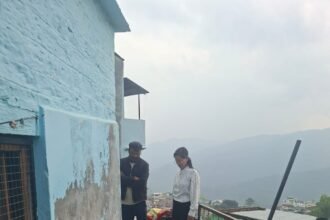



Nestled in the serene and sacred Himalayan valley of Ranikhet, The Pleasant Valley School has emerged as far more than an academic establishment. It has evolved into a living embodiment of India’s civilizational ethos—a vibrant cultural pilgrimage and a distinguished Cultural Ambassador of Indian heritage, values, and consciousness.
Set against the backdrop of towering Himalayan ranges, enveloped by dense deodar forests and pristine natural beauty, the school campus transforms each year during the auspicious days of Navratra into a space of profound cultural awakening. The annual staging of Ram Leela here transcends theatrical performance; it becomes a deeply immersive spiritual dialogue, a revival of cultural memory, and a powerful awakening of moral consciousness among students and the wider community.
Unlike many institutions where cultural observances remain symbolic, The Pleasant Valley School stands among the rare educational institutions in the country where Ram Leela is not merely a tradition, but a sustained cultural commitment observed every year with unwavering devotion. Here, the Ramayana is not confined to textbooks; it is lived, experienced, and internalised as a guiding philosophy that shapes young minds through the timeless values of Dharma, truth, duty, and righteous conduct.
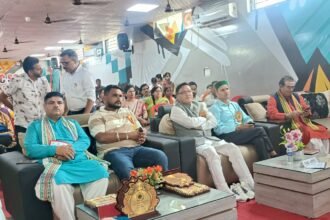
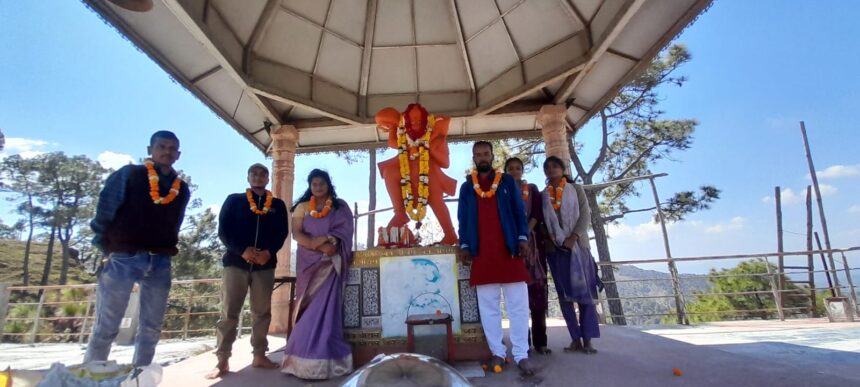
Reinforcing this cultural continuum, a 24-hour “Shri Akhand Ramayan Path” was recently conducted on 18 and 19 April 2026 at the school’s Hanuman Temple premises, culminating on the auspicious occasion of Akshaya Tritiya. The sacred event was conducted with full ritualistic devotion and religious discipline. The dedicated teaching faculty—Ms. Monika Joshi, Ms. Neelam Sharma, Mr. Ashwin Kumar, Mr. Nitin Singh Bartwal, Ms. Karina, and Ms. Himani Adhikari—along with the entire school fraternity, played an exemplary role in welcoming and serving devotees, reinforcing the belief that culture is not merely taught, but lived and embodied.
The event witnessed the gracious presence of teachers, staff, students, parents, and members of the local community in large numbers. The cultural richness of the occasion was further elevated by the presence of renowned Bhojpuri poet Dr. Santosh Patel and his wife, Mrs. Raanu Ji, whose participation added literary and artistic depth to the spiritual gathering.
The ceremony was further dignified by the presence of Dr. Jwala Prasad, former Director of Gandhi Smriti and Darshan Samiti, Government of India. Notably, he was conferred the Mahatma Gandhi Leadership Award on 2 October 2024 at Oxford, London, United Kingdom, on the occasion of the 155th birth anniversary of the Father of the Nation, Mahatma Gandhi. His presence brought intellectual and national significance to the event.
Senior journalist and Vice President of Working Journalists of India (WJI), Delhi Pradesh, Shri Eesh Malik, attended the event as a Special Invitee, alongside prominent educationist and corporate school operator Shri Puneet Yadav, who also graced the occasion as a Special Guest.
The Akhand Ramayan celebration was further enriched by the participation of several members of the Bajrang Dal and the Vishwa Hindu Parishad, lending it a wider social and cultural dimension. Additionally, several senior leaders of the Bharatiya Janata Party from Delhi extended their greetings, including senior BJP MLA Shri Jitendra Mahajan, who has previously also graced the school’s Ram Leela Mahotsav.
The entire gathering stood as a remarkable testimony to unity in diversity, where spirituality, culture, education, and social participation converged in a rare and powerful expression of collective Indian identity—an achievement that firmly establishes The Pleasant Valley School as a true Cultural Ambassador of the nation.
Every year, as the nine sacred nights of Navratra descend upon the serene Himalayan slopes of Ranikhet, The Pleasant Valley School undergoes a remarkable transformation. It ceases to be merely an academic institution and emerges instead as a living theatre of civilizational memory—an arena where culture, education, and philosophy converge in a profoundly symbolic expression of India’s intangible heritage.
The annual staging of Ram Leela on the school campus is far more than a ceremonial event. It is a deliberate and conscious act of cultural continuity, a reaffirmation that true education cannot be confined within the boundaries of textbooks. Instead, it must expand into the moral imagination, ethical reasoning, and philosophical inquiry of young minds. In doing so, the institution positions itself not only as a center of learning but also as a custodian of cultural consciousness.
In an era defined by rapid technological acceleration, cultural fragmentation, and increasing global homogenization, the school’s unwavering commitment to Ram Leela stands as a quiet yet profoundly assertive statement: India’s civilizational heritage is not ornamental nostalgia, but foundational wisdom. The epic of Lord Rama is not presented as a distant mythological memory, but as an enduring moral compass—one that privileges duty over desire, righteousness over convenience, and truth over expediency.
Importantly, the Ramayana narrative is not reduced to a simplistic moral binary of good versus evil. Instead, it becomes a platform for intellectual and ethical engagement, prompting both students and audiences to confront complex questions: What constitutes dharma in morally ambiguous circumstances? How does one uphold integrity when compromise appears easier? Can authority ever be justified without ethical grounding? Through performance, dialogue, and reflection, Ram Leela evolves into a living philosophical discourse.
For the students of The Pleasant Valley School, participation is deeply transformative. It cultivates not only artistic expression but also empathy, introspection, and moral awareness. By embodying figures such as Rama, Sita, Lakshmana, and even Ravana, students engage with archetypes that have shaped Indian civilizational thought for millennia. In the process, they transition from passive recipients of tradition to active interpreters of its meaning.
Equally significant is the collective spirit that defines this tradition. Teachers, students, parents, and the wider community come together in an atmosphere of shared devotion and creativity. The synchronized chanting, meticulous preparation of costumes, and dedicated rehearsals reflect a rare harmony—one that reaffirms that culture thrives not in isolation, but through participation and shared experience.
The alignment of Ram Leela with Navratra adds deeper symbolic resonance. These nine nights, devoted to the worship of the Divine Feminine, culminate in the celebration of light over darkness. By integrating Ram Leela into this sacred cycle, the school interweaves two profound spiritual strands of Indian tradition, reinforcing a holistic worldview rooted in balance—Shakti and Dharma, energy and righteousness.
Ultimately, this annual observance asserts continuity in a fragmented age. It demonstrates that heritage is not preserved through passive admiration, but through active, lived engagement. The commitment of The Pleasant Valley School is therefore not merely commendable—it is essential.
In nurturing such narratives, values, and shared cultural experiences, the school is shaping individuals who are not only academically competent but also culturally anchored and morally conscious. In this lies its greatest contribution—not merely the theatrical triumph of good over evil, but the deeper triumph of wisdom over ignorance in life.